 Home
Home
 Lessons
 Exercises
 Tenses
 Writing
 Vocabulary

 Lists
Lists
 Glossary
Types of Adjectives Used in English (with Examples)
Different types of adjectives in English! Learn types of adjectives English students should know with example sentences.
Adjectives modify nouns and pronouns . In general, two main types of adjectives are:
- Descriptive adjectives describe characteristics of the noun.
- While, Limiting adjectives limit the noun being described.
Table of Contents
Types of Adjectives:
Descriptive Adjectives
What is a descriptive adjective in English?
Generally, a descriptive adjective is probably what you think of when you hear the word “adjective.” Descriptive adjectives describe nouns and pronouns.
In fact, descriptive adjectives can be attributive adjectives or predicate adjectives .
Attributive Adjectives
Adjectives which appear directly beside the noun, most commonly before, are called attributive, because they attribute a quality to the noun they modify. And, more than one adjective can modify the same noun.
Examples:
-
The flowers have a nice smell.
(“Nice” is an attributive adjective, as it is placed).
-
The chatter made the room noisy.
(This is an instance in which the attributive adjective appears directly behind the noun. “Noisy” is describing the “room.”)
Predicate Adjectives
Adjectives which appear after a linking verb are predicative adjectives , because they form part of the predicate. Hence, they modify the subject of the sentence or clause (a clause is a portion of a sentence which contains a subject and a predicate).
Examples:
- The pickles are salty.
( noun : pickle, linking verb : are, adjective : salty (describing the noun”pickles”))
- Tornadoes appear menacing.
( noun : tornadoes, linking verb : appear, adjective : menacing (describing the noun “tornadoes”)
Types of Adjectives: Limiting Adjectives
Limiting adjectives do as their name suggests, they limit the noun being described. Generally, there are 11 types of limiting adjectives as follows:
- Definite & Indefinite Articles
- Possessive Adjectives
- Demonstrative Adjectives
- Indefinite Adjectives
- Interrogative Adjectives
- Cardinal Adjectives
- Ordinal Adjectives
- Proper Adjectives
- Nouns used as Adjectives
- Denominal Adjectives (Proper and not proper)
- Nominal Adjectives
Definite & Indefinite Articles
There is only one definite article , the. When used before a noun, it specifies a particular noun as opposed to any one.
Examples:
- The cat (a specific, identifiable cat)
- The cottages (specific, identifiable cottages)
There are two indefinite articles , a and an. These are used with a noun when a specific noun is not being pointed at.
Examples:
- A lion (any lion)
- An ant (any ant)
Possessive Adjectives
The possessive adjectives my, your, his, her, its, our, and their modify nouns by showing possession or ownership.
Examples:
- I forgot my key at home.
- What is your phone number?
- The bookstore sold his favorite book.
- After many years, they returned to their homeland.
- We’ll make our decision and contact the people involved.
- The cat chased its ball down the stairs and into the backyard.
Demonstrative Adjectives
What are demonstrative adjectives in English?
The demonstrative adjectives “this,” “these,” “that,” “those,” and “what” are identical to the demonstrative pronouns , but are used as adjectives to modify nouns or noun phrases.
Examples:
- That dog is so adorable.
- He lives in this house.
- My friend preferred those plates.
- These books are too expensive.
The relationship between a demonstrative adjective and a demonstrative pronoun is similar to the relationship between a possessive adjective and a possessive pronoun , or to that between a interrogative adjective and an interrogative pronoun.
Interrogative Adjectives
What is an interrogative adjective in English?
An interrogative adjective (“which” or “what”) is like an interrogative pronoun, except that it modifies a noun or noun phrase rather than standing on its own (see also demonstrative adjectives and possessive adjectives).
Examples:
- Which method is likely to produce the best results?
- What subject did you enjoy most?
Indefinite Adjectives
What is an indefinite adjective in English?
An indefinite adjective is similar to an indefinite pronoun , except that it modifies a noun , pronoun , or noun phrase.
Examples:
- Many people continue to ignore warnings about the dangers of sunbathing.
- The examiners can pitch on any student to answer questions.
- There were a few people sitting at the back of the hall.
-
All children should be taught to swim.
Cardinal Adjectives
Adjectives that modify the noun by numbering it (stating how many) are cardinal adjectives.
Examples:
- Five pens
- Six tables
Ordinal Adjectives
An ordinal adjective indicates the position of a noun in a series.
Examples:
- The first date
- The third month
Proper Adjectives
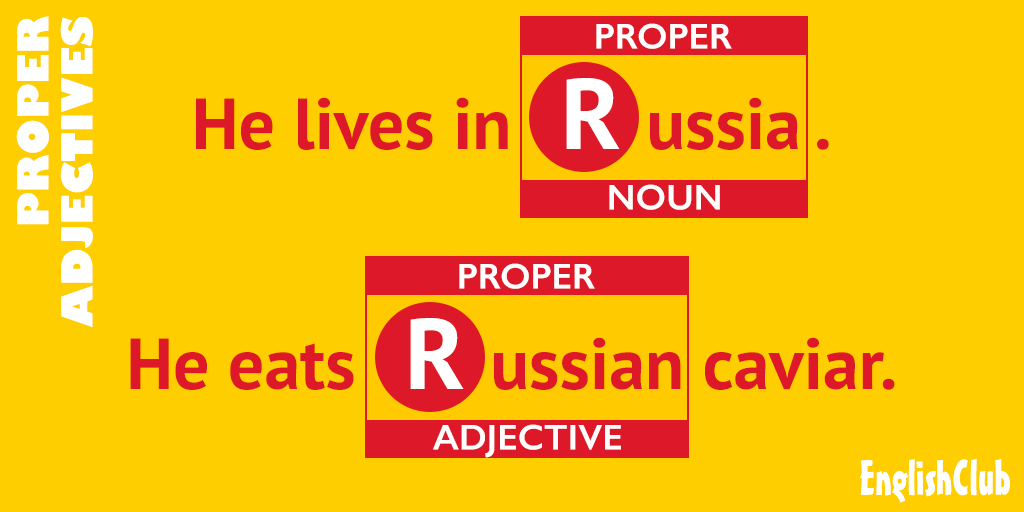
Adjectives derived from proper names are called proper adjectives. They are easily recognizable in that they are always capitalized.
Examples:
- Japanese food
- Russian opera
- a Trumpian tweet,
- a Shakespearean play,
- the Thai baht,
- French cars
Each of the four examples above contains an adjective ( Trumpian, Shakespearean, Thai, French ) and you will immediately note that each adjective is capitalized—it starts with a capital letter . That is because each of those adjectives comes from a name ( Trump, Shakespeare, Thailand, France ). Names of people, organizations, countries, towns etc are " proper nouns " and need to be capitalized in English. Adjectives made from proper nouns are "proper adjectives" and also need to be capitalized.
Proper nouns are nouns that refer to unique places, people or organizations. The word "country" is a common noun because there are many countries. The word "Thailand" is a proper noun because there is only one Thailand and Thailand is its name. Just like you. You are unique and you have a name. Your name is a proper noun and in English we spell it with a capital letter at the start (example E lizabeth, D onald ).
What are Proper Adjectives?
Most adjectives are " common adjectives ". They describe people, places and things, for example:
Examples:
- tall man, big dog, noisy baby
- large garden, empty room, beautiful city
- red car, hot weather, expensive watch
" Proper adjectives " also describe people, places and things, but they are based on names and therefore need to be capitalized, like the names. For example, Spain is the name of a country and starts with a capital letter. The adjective based on Spain ( Spanish ) must also start with a capital letter. Mars is the name of a planet and starts with a capital letter. The adjective based on Mars ( Martian ) must also start with a capital letter. Shakespeare was the name of a famous writer and starts with a capital letter. The adjective based on Shakespeare ( Shakespearean ) must also start with a capital letter.
Examples:
- Since you live in Spain, do you enjoy Spanish food?
- If people ever live on the planet Mars, they will have to endure the extremes of the Martian climate.
- Although William Shakespeare is best known for his plays, many exams also cover Shakespearean poetry.
Proper adjectives are mostly of two types :
Examples:
- those that come from names of places —countries, continents, regions, cities
- those that come from names of people —usually famous people, mostly historical, some modern
Nouns Used as Adjectives
Sometimes nouns can be used as adjectives to define or describe another noun.
Examples:
- The computer exhibition
- A history teacher
Denominal adjectives
What are denominal adjectives?
Denominal adjectives (sometimes called denominal adjectives) are adjectives derived from nouns . For example:
- A mathematical puzzle. (a puzzle based on mathematics)
- A biological experiment. (an experiment in biology)
- A wooden boat. (a boat made of wood)
Proper adjectives are derived from proper nouns. They commonly describe something in terms of nationality, religious affiliation, or culture. Like proper nouns, proper adjectives have their first letter capitalized. For example:
- I married a Russian woman.
- The Jewish community in NY is very large.
Adjectives of this type should be carefully distinguished from adjectives denoting nationalities (nominal adjectives). For example:
- Denominal Adjective : The French people are noted for their wines.
- Nominal Adjective : The French are noted for their wines.
or:
- Denominal Adjective : The poor people are more vulnerable.
- Nominal Adjective : The poor are getting poorer.
Examples
- A mathematical puzzle.
- A biological experiment.
- A wooden boat.
- I married an American woman.
- The Jewish community in NY is very big.
- Mary has a collection of expensive Russian dolls.
- In the winter you must wear heavy woolen clothes.
- The polar bear is listed as threatened.
Nominal Adjectives
Tính từ có vai trò như danh từ
Certain adjectives are used to denote a class by describing one of the attributes of the class . For example, the poor denotes a class of people who share a similar financial status. Other nominal adjectives are:
- the old
- the sick
- the wealthy
- the blind
- the innocent
A major subclass of nominal adjectives refers to nationalities:
- the French
- the British
- the Japanese
However, not all nationalities have corresponding nominal adjectives . Many of them are denoted by plural, proper nouns:
- the Germans
- the Russians
- the Americans
- the Poles
Nominal adjectives do not refer exclusively to classes of people. Indeed some of them do not denote classes at all:
- the opposite
- the contrary
- the good
Comparative and superlative forms can also be nominal adjectives:
- the best is yet to come
- the elder of the two
- the greatest of these
- the most important among them
We refer to all of these types as nominal adjectives because they share some of the characteristics of nouns (hence ` nominal ') and some of the characteristics of adjectives. They have the following nominal characteristics:
-
they are
preceded by a determiner
(usually the definite article the )
-
they can be modified by adjectives
(the gallant French , the unfortunate poor )
They have the following adjectival features :
-
they are gradable
(the very old , the extremely wealthy )
-
many can take comparative and superlative forms
(the poorer , the poorest )